Use standalone statistical and legacy data through a governed path — directly in Power BI when analysts need the data, or through governed movement when the data belongs in a modern cloud or lakehouse platform.
Portus begins by understanding the source correctly. From that common governed foundation, the data follows the path required by the use case: direct governed consumption in Power BI, or governed movement into a modern data platform.
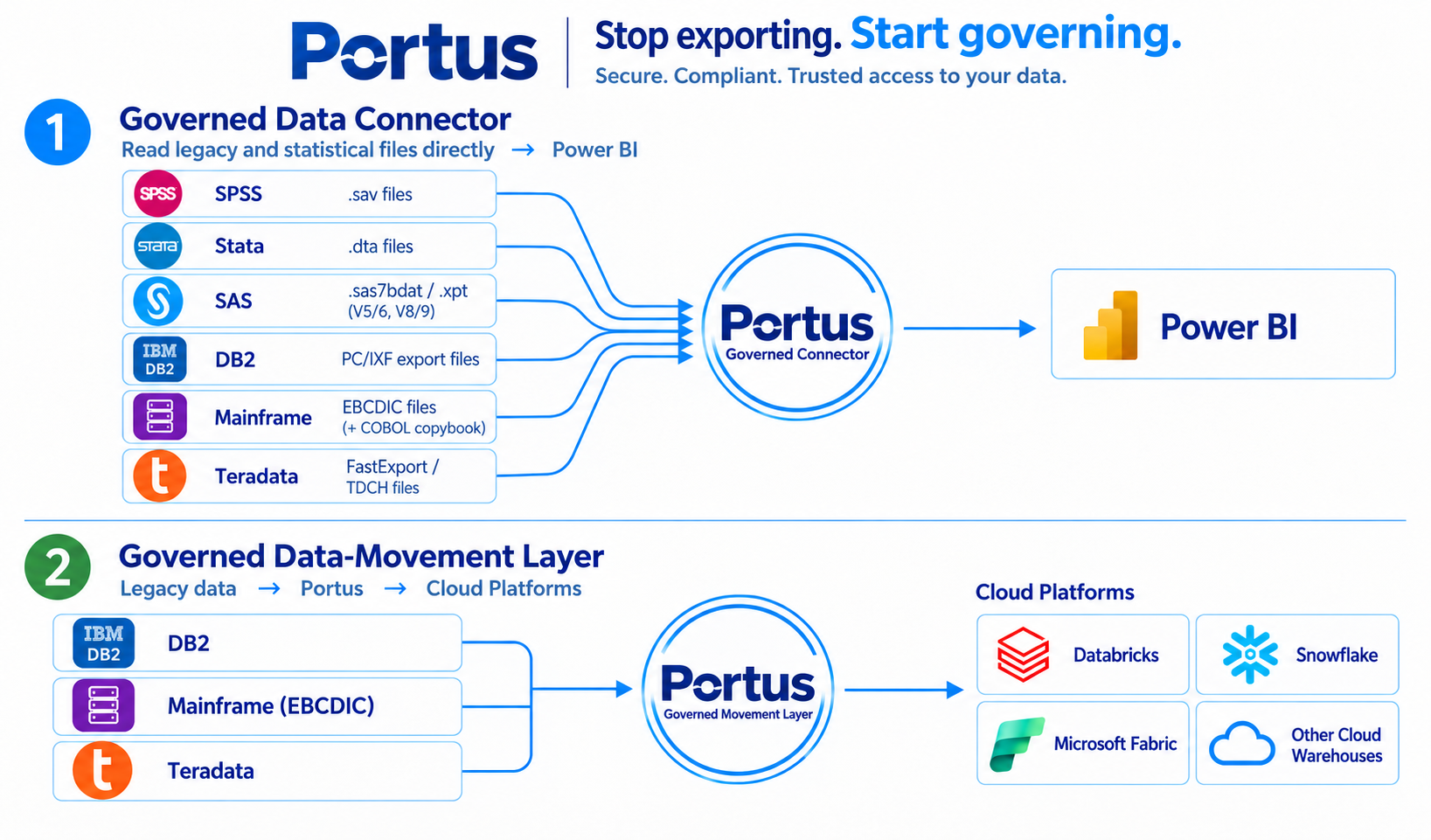
Portus reads the supported native source format directly, interprets its structure and presents usable data through the governed Power BI connector.
Portus uses the same governed foundation to move supported source data into the required cloud or lakehouse platform while preserving fidelity and verification evidence.
The operating paths share the same technical foundation. Portus first interprets the supported native source representation and preserves it in one exact model. The use case then determines the operating path.
Portus connects supported source data to Power BI through a governed, read-only connector. The direct reader understands the native source representation, so the analyst does not first have to turn the data into CSV, Excel or another intermediate working copy.
Reads SPSS data files directly for governed Power BI consumption.
Reads Stata data files directly for governed Power BI consumption.
Reads SAS datasets and supported SAS transport files directly.
Reads DB2 PC/IXF export and interchange files without connecting back to DB2.
Uses the associated copybook to interpret the EBCDIC record layout, fields and structure.
Reads supported Teradata FastExport data without connecting back to Teradata.
The format-specific work stays inside the Portus reader. Power BI receives usable data through the governed connector.
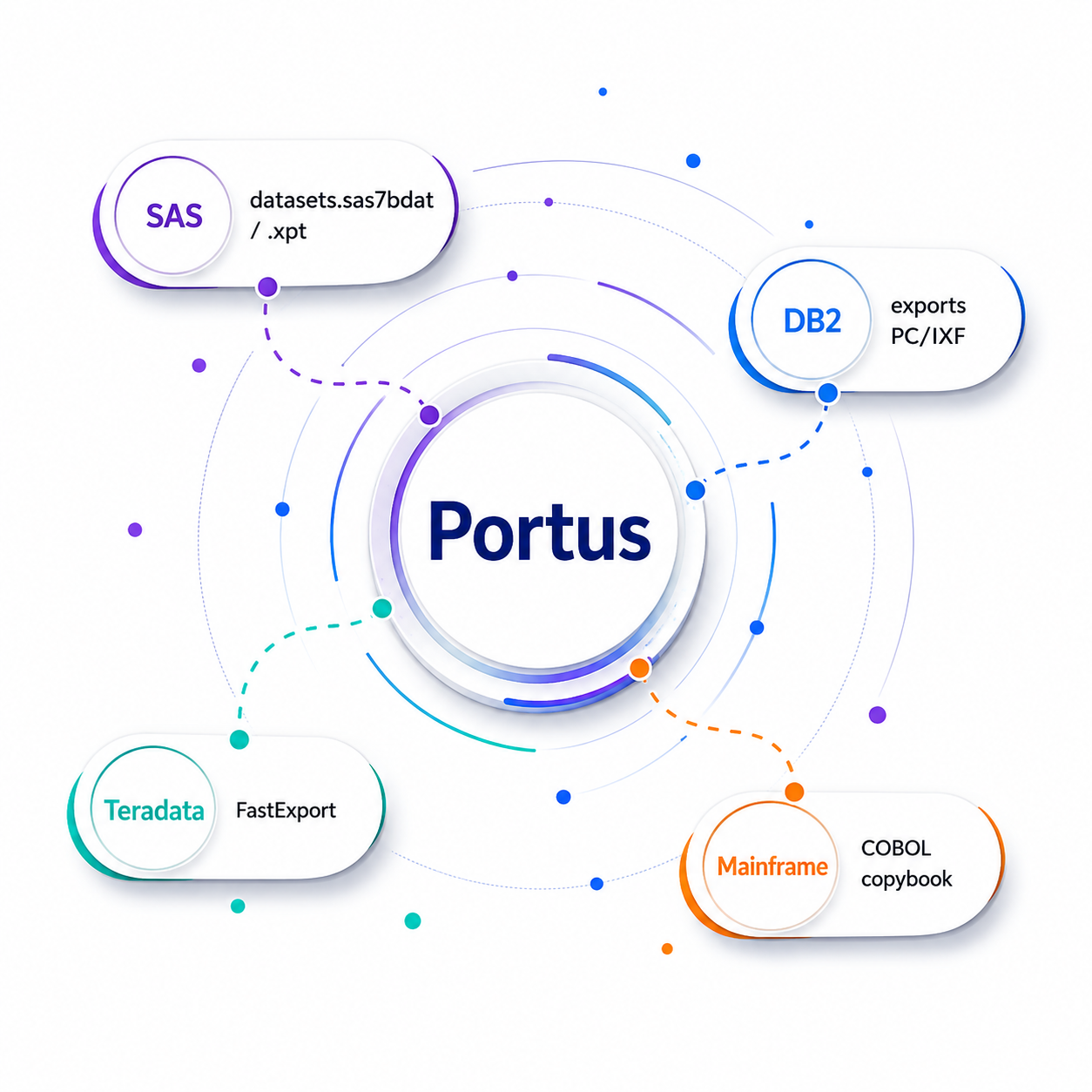
The difference is the path to usable data. Portus reads the supported source representation directly instead of making a manually converted working file the prerequisite for Power BI consumption.
The same fidelity and evidence discipline supports the governed foundation and carries into the operating path.
DECIMAL stays exact decimal, integers retain their true width, timestamps preserve their precision, and binary remains binary.
Each governed conversion emits signed evidence including the source hash, row-equivalence digest and output hash.
A dependency-free reference verifier and published specification allow the evidence to be checked independently.
When the consumption objective is a modern cloud or lakehouse platform rather than direct Power BI access, Portus uses the same governed reader foundation as a data-movement layer. The source is interpreted first, preserved through the exact model, and then delivered into the required target with the fidelity and evidence chain retained.
Portus interprets supported DB2, mainframe and Teradata source data through the format-aware reader.
The interpreted data passes through the common exact model so the source fidelity remains part of the movement.
The governed output is delivered into the required modern platform with signed evidence accompanying the operation.
The target platform can change without changing the source-reading discipline or the governed foundation.
The destination changes. The fidelity and verification discipline remain.
The architecture below consolidates the two operating paths already described: governed direct access to Power BI and governed data movement into modern data platforms.
Use representative source files from your environment and validate the Portus operating path required for your use case.
Use supported formats that matter in your environment. The files stay in your environment.
Use the governed connector for Power BI, or validate the governed movement path for the required modern platform.
Review the resulting data, fidelity evidence and independent verification material.